Car Driving & Parking Academy
- 4.6
- Rating
- 1.00M
- Installs
- Free
- Price
 Analysis by App-foxy
I approached Car Driving & Parking Academy as a focused driving game rather than a full racing spectacle. Its central appeal is simple: it puts parking and careful vehicle control ahead of speed. That makes it a different kind of racing title, one where the satisfying moment is not crossing a finish line first, but placing a car correctly without losing patience or control.
The game is developed by Safari MMS and is free to play, with an Everyone age rating that makes it suitable for a broad audience. It belongs to the racing category, although its strongest identity comes from car parking practice. I found that distinction important before starting, because anyone expecting constant high-speed competition may find the rhythm slower than expected. Players who enjoy precision, repetition, and improving small driving mistakes are much more likely to appreciate it.
Why the parking-focused capability matters
The most useful idea here is that parking is treated as the main driving challenge rather than a minor activity between races. That changes how I played. I stopped looking for the quickest route and started thinking about steering angle, available space, approach speed, and the order in which I needed to make corrections.
You May Also Like

 Pandora - Music & Podcasts
Pandora’s Music Is Easy to Start, but Harder to Recover
Pandora’s strength is its low-effort path from a seed to a station. Its weak spot is how much confidence it asks you to place in connection, setup, and quiet recovery.

 AccuWeather: Weather Radar
AccuWeather Review: A Quick, Clear Forecast for Everyday Decisions
For everyday plans, the best forecast is the one you can understand quickly. AccuWeather makes rain timing, radar, and local conditions easy to act on, with a few trade-offs.

 Hill Climb Racing
Why Hill Climb Racing Still Turns Crashes Into One More Run
A tiny car, a bumpy hill and one more upgrade: Hill Climb Racing keeps resurfacing because its simple chaos makes every near-miss feel personal.

 AliExpress - Shopping App
AliExpress Makes Global Shopping Feel Personal, but Shoppers Bear the Risk
AliExpress turns a global marketplace into a pocket-sized discovery engine. Its reach is useful, its shopping loop compelling, and its trade-offs easy to miss.

 Lords Mobile: Kingdom Wars
Lords Mobile Is a Kingdom-Building Routine, Not a Quick Match
A case-by-case verdict on the building, battles, device demands, and social commitments that make Lords Mobile rewarding for some players and exhausting for others.

 PDF Scanner app - TapScanner
TapScanner Makes Paperwork Easier to Capture, Check, and Share
TapScanner makes scanning with a phone feel less like a rescue operation and more like a dependable step in getting work done. Its capture tools are useful, though not flawless.
More From Our News Desk
View All News


That sounds modest, but it gives the game a clearer purpose than many casual racing titles. Fast racing games usually reward acceleration, overtaking, and bold movement. This one asks for restraint. A move that would be harmless in an arcade racer can ruin a parking attempt when the goal is to finish neatly and accurately.
In practice, the capability works best as a short concentration exercise. I could play for a few minutes, focus on one maneuver, and stop without feeling that I had abandoned a long race. The format suits people who want a driving-themed game during a break, especially when they prefer a task with a clear beginning and end.
The main strength is the change in priorities: progress comes from controlled decisions, not simply from pressing the accelerator. That gives each attempt a useful lesson, even when the result is not perfect. I became more aware of how early I should begin a turn and how much space I was leaving for the vehicle to straighten.
How the driving challenge feels in practice
My first recommendation is to treat the opening attempts as familiarization rather than tests of skill. I spent time learning how sensitive the controls felt and how quickly the car responded to steering input. Rushing immediately toward the parking position made me overcorrect. A slower approach gave me more time to recognize whether I was entering at the wrong angle.
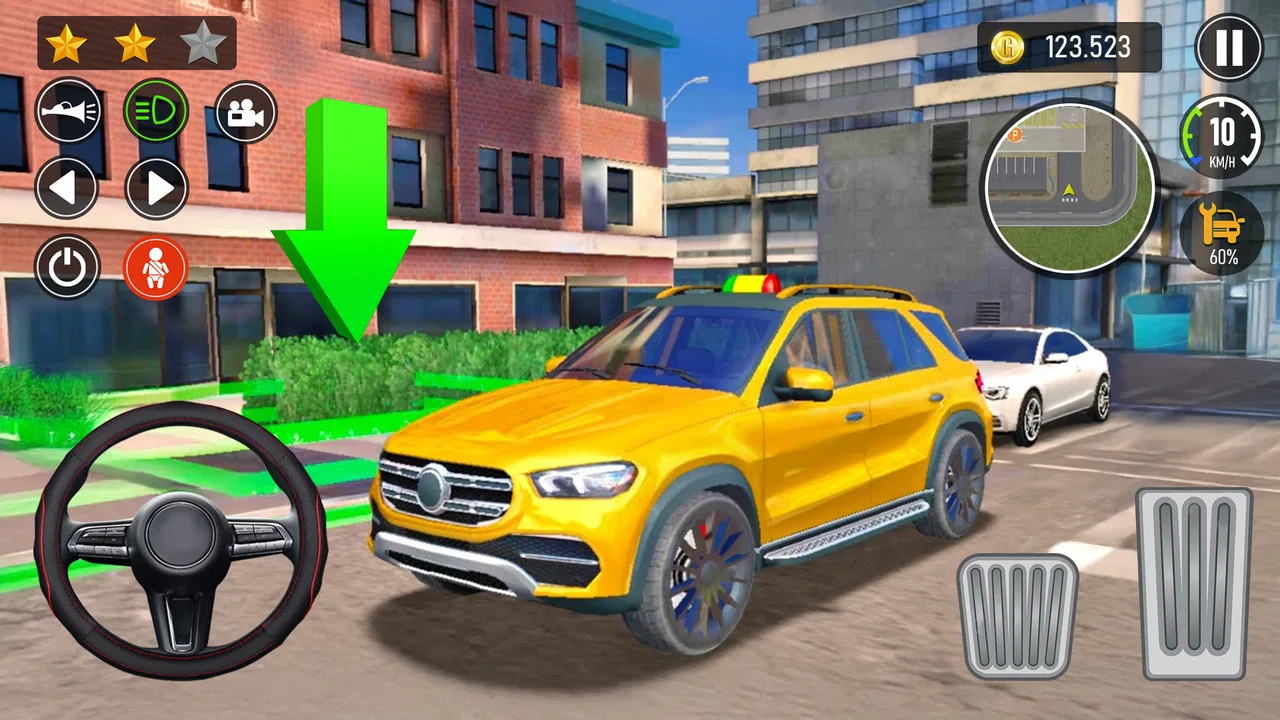
This is where the game can be more demanding than its straightforward presentation suggests. Parking looks easy when viewed from above or from a distance, but small errors become obvious when the available space is limited. I found that tapping or moving the controls too aggressively created a chain of corrections: one turn led to another, and the car ended up facing the wrong direction.
A better workflow is to divide every maneuver into three stages. First, I lined up the approach instead of aiming directly at the destination. Second, I made the main turn early enough to avoid a last-second swing. Third, I used very small adjustments to settle the car. This method is more reliable than trying to solve the entire maneuver with one dramatic movement.
Another useful habit is to pause mentally before moving. Even when the game is designed for casual play, I benefited from checking the space around the target and deciding where the car should be pointing halfway through the turn. That intermediate position matters. If the vehicle is already badly angled before the final approach, tiny steering corrections rarely rescue the attempt.
The game also works as a gentle introduction to spatial judgment for players who do not normally play driving games. It does not require the same reflexes as an arcade racer, so a younger player or a newcomer can concentrate on direction and positioning. The Everyone rating supports that broad accessibility, although younger users may still need help understanding why slow, deliberate inputs are more effective than constant movement.
A realistic everyday session
Imagine having a short wait before an appointment. A conventional racing game may tempt you into starting a full event that you cannot finish comfortably. This parking game fits that moment better. I could begin an attempt, focus on the approach, and put the phone away after completing or restarting a maneuver without needing to remember a complicated story or manage a large progression system.
It is also a reasonable choice for someone who wants a calmer alternative to competitive racing. After a busy day, I often prefer a game that asks me to pay attention without making me react to several opponents at once. The parking focus creates that quieter pace. It is not relaxing in the same way as an idle game, because mistakes still require concentration, but the pressure feels more personal and controlled.
For a parent choosing a simple driving title, the appeal is similarly clear. The game presents a familiar real-world activity in a playful form, and the age rating is Everyone. I would still suggest trying it together at first, because the best way to enjoy it is to discuss why a particular approach failed rather than simply retrying without changing anything.
Small techniques that make a difference
One technique that helped me was using the outer edge of the available space as a visual reference. Instead of staring only at the parking target, I watched how much room remained on the side of the vehicle during the turn. This reduced the tendency to focus on the front while forgetting that the rear follows a wider path.
I also learned not to correct too quickly after a mistake. If the car began drifting away from the intended line, my first instinct was to swing the steering in the opposite direction. That often created a second error. A brief reduction in movement, followed by a measured correction, produced a straighter recovery.
A third insight is that the best route is not always the shortest-looking route. Approaching directly may seem efficient, but it can leave no room to straighten the vehicle. A slightly wider setup can make the final placement easier. This is one of the more valuable lessons in the game because it rewards planning rather than visual impatience.
These techniques are not advanced features in the usual technical sense, but they are advanced ways to use the game. The store summary presents a starting point for becoming a better driver; the practical value comes from turning each attempt into a small exercise in observation and correction.
Where it differs from ordinary racing games
Compared with a typical arcade racer, the game has a narrower focus. There is less reason to chase speed for its own sake, and the satisfaction comes from completing a controlled maneuver. Players who enjoy drifting, overtaking, dramatic tracks, or constant competition may prefer a conventional racing title.
On the other hand, ordinary racing games can make parking feel like an afterthought. Their controls are often tuned for broad movement and quick reactions, not for careful positioning. A parking-centered game gives that specific skill more room to matter. If your goal is to improve your sense of vehicle placement inside a game, this is the more relevant option.
I would not treat it as a realistic driving simulator. Its value is in simplified practice and game-like repetition, not in replacing formal instruction or reproducing every detail of driving a real car. That distinction is important for anyone hoping to learn road rules, traffic behavior, or real-world safety procedures. This is best understood as a casual control and spatial-awareness game.
The tradeoffs behind the focused design
The same concentration that makes the game approachable can also make it feel limited. Once I understood the basic rhythm of approaching, turning, and correcting, I wanted more variety in the challenge. Players who need a wide selection of modes may find the parking emphasis repetitive over longer sessions.
There is also a difference between useful repetition and frustrating repetition. Repeating a maneuver is satisfying when I can identify the mistake and adjust my method. It becomes less enjoyable when an attempt fails but the reason is difficult to read from the screen. For that reason, I recommend playing in a quiet setting and giving each failure a specific interpretation: wrong approach, excessive speed, late turn, or overcorrection.
The free price makes it easy to try without a financial commitment, which is a strong advantage for a casual game. Still, free access alone does not guarantee that it will suit everyone. Someone looking for a deep long-term racing career may quickly reach the limits of what this focused format offers, while someone who enjoys short skill-based sessions may find exactly the right level of commitment.
The game is available with a minimum operating system requirement of Android 7.0, so it can suit many older Android devices. That is helpful for players who do not own a recent phone. At the same time, older hardware can make any control-based game less comfortable if the device responds slowly or the display is cramped, so I would use the largest, most responsive screen available when precision matters.
Who will benefit most from the parking approach
I think the strongest audience is made up of players who enjoy gradual improvement. If you like noticing that your second attempt was cleaner than your first, the game gives you a straightforward reason to keep going. It is also a good fit for people who find high-speed racing stressful but still want a vehicle-based game with clear objectives.
It can work well for beginners because the basic concept is immediately understandable. You do not need to learn a complicated fictional world before playing. The challenge is visible: position the car carefully and avoid wasting movement. That simplicity makes it suitable for occasional players who do not want to memorize extensive systems.
More experienced racing fans may still enjoy it as a change of pace. I found that switching from speed-focused games to parking-focused play exposed a different weakness in my own habits. I was comfortable reacting quickly, but less comfortable setting up a turn several moments in advance. The game is useful in that narrow sense: it makes spatial planning the thing I have to practice.
I would suggest skipping it if your main reason for installing a racing game is competition against opponents, spectacular speed, or a large variety of vehicles and events. A traditional arcade racer will probably provide more excitement in those areas. I would also look elsewhere if you want a serious driving education tool, because this game should not be mistaken for professional instruction.
What the current release tells me about trying it now
The current version is 1.1.8, and the game has passed the one-million-install mark. Its average rating is 4.6 from around 700 ratings, with one written review shown alongside that score. Those figures suggest that the simple parking concept has found an audience, but I would still judge it by your preferred style of play rather than by popularity alone.
For me, the appeal is clearest when I use it with a purpose: a few attempts to practice careful positioning, a short session during a wait, or a calmer alternative after playing faster racing games. It is less convincing as an all-day game because the central activity can become familiar once the basic technique is understood.
My practical advice is to begin slowly, use the first attempts to learn the steering response, and change one decision at a time after a failed maneuver. Do not simply move faster on the next try. Improve the approach, create more room for the turn, and finish with small corrections. That is where the game delivers more than its brief store description suggests.
Overall, I recommend Car Driving & Parking Academy to anyone who wants a free, accessible racing game built around precision instead of speed. Its focused design is both its biggest strength and its clearest limitation. If you enjoy turning small driving mistakes into visible improvements, it is worth trying; if you want nonstop racing action, choose a different kind of game.
FAQs for Car Driving & Parking Academy
01What is Car Driving & Parking Academy?
Car Driving & Parking Academy is a mobile driving simulator focused on learning and practicing everyday vehicle control. It combines road-driving challenges with parking exercises, requiring you to steer, brake, accelerate, follow routes, and position the car accurately. The game is designed for casual players who enjoy realistic driving tasks, structured lessons, and progressively more difficult scenarios rather than fast arcade racing.
02How do you play Car Driving & Parking Academy?
Gameplay generally involves completing driving lessons, navigating marked routes, and parking the vehicle inside designated spaces without hitting obstacles or breaking traffic rules. On-screen controls allow you to manage steering, acceleration, braking, and sometimes camera views. Each challenge rewards careful movement and precision, so reducing speed before turns and checking your surroundings is usually more effective than driving aggressively.
03Is Car Driving & Parking Academy suitable for beginners?
Yes, the game is suitable for beginners because its main activities are based on fundamental driving skills rather than competitive racing. New players can become familiar with steering sensitivity, braking distance, reversing, and parking alignment through repeated attempts. However, some later missions may demand patience and accurate control, especially when spaces are narrow or penalties are applied for collisions and incorrect positioning.
04Does Car Driving & Parking Academy require an internet connection?
The basic driving and parking activities may be playable offline, depending on the version installed and the device platform. An internet connection can still be required for advertisements, updates, cloud-related features, analytics, or optional content. Before starting a long session without Wi-Fi or mobile data, it is best to open the game once while connected and check whether all desired modes are available offline.
05Is Car Driving & Parking Academy free to download and play?
Car Driving & Parking Academy is typically available as a free download, but free access may include advertisements, optional purchases, or restrictions on certain vehicles, stages, and customization features. The exact monetization system can vary between Android and iOS versions and may change with updates. Review the store listing and in-app purchase information before downloading if you want to avoid unexpected costs.
Pros
- Realistic driving physics make parking practice feel engaging.
- Multiple vehicle types offer variety beyond basic car controls.
- Progressive challenges help players improve driving precision.
- Offline play is convenient for travel or limited connections.
- Simple controls make the game approachable for casual players.
Cons
- Some levels may feel repetitive after mastering the core tasks.
- Precision requirements can make certain parking challenges frustrating.
- Vehicle upgrades or extras may depend on in-app purchases.
- Graphics may look dated on newer phones and tablets.
- Ads can interrupt play
- especially between completed challenges.

Car Driving & Parking Academy
Gallery